About Minak
Who is
minak?
Minak’s practice occupies a poised and assured position within contemporary painting, where disciplined thought meets lyrical intuition. Before committing fully to her studio, she built a successful career as a corporate lawyer an experience that continues to inform the structural intelligence and conceptual clarity evident in her work. Her transition to painting was not an abandonment of one world for another, but a deliberate recalibration of method: from the interpretation of legal frameworks to the construction of visual ones.
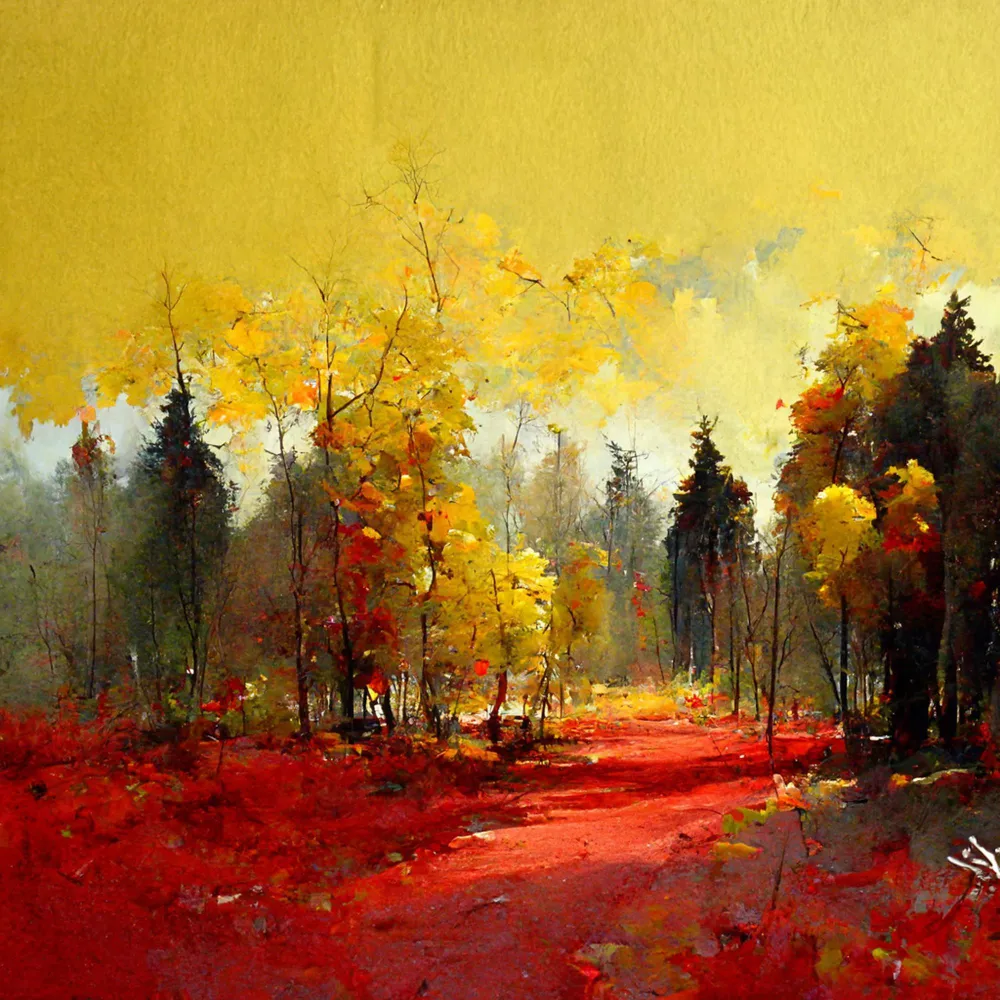
Working across impressionism, surrealism, and abstraction, Minak approaches nature not as motif but as inquiry. Her canvases explore the mutable relationship between perception and memory, between the tangible landscape and its psychological echo. Atmosphere plays a central role: light is diffused, forms hover at the edge of recognition, and space unfolds in layered chromatic fields that suggest both immediacy and distance.
There is a notable compositional authority in her paintings. Gestural passages are counterbalanced by areas of restraint; spontaneity is held within an underlying architecture. This equilibrium reflects a mature sensibility one that understands tension, silence, and pause as essential components of visual language. Rather than seeking spectacle, Minak cultivates sustained engagement. Her works reveal themselves gradually, inviting the viewer into a contemplative dialogue.
Nature, in her vocabulary, is neither romantic nor decorative. It is a philosophical terrain through which questions of transience, interiority, and transformation are quietly negotiated. The result is a body of work that feels at once grounded and expansive, intimate yet universally resonant.
Now fully dedicated to her artistic practice, Minak has established herself as a serious and respected contemporary voice. Her paintings stand confidently within an international discourse, defined by intellectual rigor, emotional maturity, and a refined command of painterly expression.

Minak’s evolution as an artist can also be understood as an expansion of inquiry rather than a change of profession. The analytical discipline cultivated through years of legal practice manifests in her studio as a sustained commitment to structure, revision, and critical self-reflection. Each body of work unfolds with deliberation. Studies, sketches, and layered revisions form an essential substratum to the finished canvas, reinforcing the sense that intuition in her practice is never arbitrary but rigorously examined.
Materiality plays a significant role in her language. She often builds surfaces through successive veils of pigment, allowing earlier decisions to remain partially visible beneath later gestures. This stratified approach produces a subtle temporal dimension: the painting becomes a record of its own making. Scraped passages, translucent glazes, and areas of impasto operate as tactile markers of thought, revealing both assertion and reconsideration. The viewer encounters not only an image, but the residue of process.
Color in Minak’s work is neither illustrative nor merely expressive; it functions architecturally. Chromatic harmonies organize spatial depth and emotional cadence. Muted tonalities frequently dominate, punctuated by moments of heightened saturation that act as visual anchors. These shifts create a rhythm that guides perception across the surface, encouraging a slow, sustained engagement rather than immediate consumption.
Her engagement with nature remains central, yet it resists literal transcription. Horizons dissolve, topographies blur, and botanical references hover between recognition and abstraction. This ambiguity becomes generative: the viewer is invited to complete the landscape through memory and association. In this way, her paintings operate as shared psychological spaces—sites where personal recollection intersects with collective environmental consciousness.
There is also an ethical undercurrent in her work. Without overt didacticism, her practice acknowledges the fragility of ecological systems and the impermanence inherent in natural cycles. Light that fades at the edge of the canvas, forms that appear to erode or reassemble, and shifting atmospheric conditions subtly echo themes of vulnerability and renewal. The paintings hold tension between preservation and dissolution, suggesting that transformation is both inevitable and generative.
Critically, Minak’s oeuvre demonstrates a refusal of stylistic rigidity. While her works move fluidly between impressionistic softness, surreal dislocation, and abstract spatial construction, they remain unified by a coherent sensibility. The through-line is not aesthetic uniformity but intellectual continuity. Each painting asks: how do we see, and how does seeing change us?
Her growing presence within contemporary exhibitions and international dialogues reflects not a trend-driven visibility, but a sustained commitment to depth. Curators and collectors respond to the quiet authority embedded in her canvases—works that neither compete for attention nor recede into passivity. Instead, they hold their ground with confidence and composure.
Ultimately, Minak’s practice affirms painting as a space of contemplative resistance in an accelerated visual culture. By privileging slowness, nuance, and layered meaning, she offers an alternative mode of engagement—one rooted in reflection rather than spectacle. Her work reminds us that visual experience can be both intellectually rigorous and emotionally expansive, and that abstraction, at its most refined, is not an escape from reality but a profound re-encounter with it.